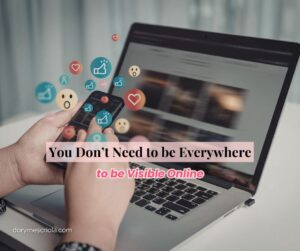

Lately, I’ve been thinking about how ridiculously easy it is to make marketing more complicated than it probably needs to be.
Post every day. Be on every platform. Build your personal brand. Start a newsletter. Make Reels. Write long-form content. Learn SEO. Do outreach. Automate everything… but apparently, don’t automate too much either. The list goes on.
And somewhere between doing all of that, you’re also supposed to actually run the business. 😅
I’ve definitely been guilty of getting caught up in all the advice, especially when they come from social media. I’d settle on a plan, start working on it, scroll past someone explaining why they built their business completely differently, and suddenly I’d be questioning mine again.
The funny thing is, I don’t think I was looking for another strategy.
I think I was just looking for reassurance that the one I chose was the right one.
And maybe that’s where I’ve been making things harder for myself.
I don’t think I need more marketing. I just need things to make more sense.
It’s really easy to assume growth means more.
More traffic. More followers. More content. More visibility. More things that are supposed to be happening.
And sure, sometimes you really do need more people to discover you. But lately, I’ve been thinking less about how many people are paying attention and more about what happens when someone actually does.
Maybe they find one of your articles through Google. Maybe someone refers them to you. Maybe they see something you shared and decide to check out your website.
They’re interested enough to look around, but maybe not interested enough. Or ready enough to contact you yet.
So… where do they go from there?
That question is probably one of the reasons I’ve become more interested in funnels and client journeys in the first place.
I’m starting to see funnels differently
The more I work on websites, copy, content, and different pieces of marketing for clients, the more I notice how much context matters.
For example, a landing page can look great and still not make much sense if you don’t know where the person came from or what you want them to do afterward. The same goes for an email sequence, lead magnet, booking form, or automation.
They’re all useful tools.
But they’re still just tools.
What interests me more is how everything connects.
What does this person already know? Why are they here? What are they trying to figure out? What might they need before they’re comfortable moving forward?
That’s why, when I talk about funnels now, I’m not necessarily imagining some giant complicated system with twenty landing pages, endless emails, upsells, downsells, and enough arrows on a funnel map to make your eyes hurt. 😂
Sometimes a funnel can be incredibly simple.
Someone discovers your business, finds something useful, and has somewhere logical to go next.
Think of it like this:
Blog post → helpful resource → email → service page → inquiry
Or:
Referral → website → service page → inquiry → call
There isn’t one magical funnel every business needs.
And honestly, I think that’s part of what I like about it.
I also don’t want my business to depend on me being online all the time
This is probably the more personal reason I keep coming back to the idea of evergreen marketing.
I’ve realized I don’t particularly enjoy the idea of constantly creating content just to prove that my business still exists. 😅 And when you’re one person trying to handle client work, prospecting, admin, learning, planning, and everything else, there’s only so much attention to go around.
I’d rather create things that can continue being useful after I’ve finished creating them.
An article can still answer someone’s question months later. A landing page can explain an offer while you’re busy working. An email sequence can follow up with someone without requiring you to remember to send every message yourself.
That doesn’t mean I want to automate every interaction either.
I still think service businesses need the human part. There are conversations, decisions, questions, and relationships that shouldn’t be handed over to a system just because they technically can be.
For me, automation makes more sense when it takes care of the repetitive stuff and gives you more room for the things that actually need you.
Maybe simpler is enough
I think this is what I keep coming back to lately.
Before adding another platform, another tool, or another strategy, I’m trying to look at what’s already there and ask whether it actually makes sense together.
Want to look at your own client journey more clearly?
Enter your name and email below to get the free Client Journey Map.
None of that sounds particularly exciting compared with all the marketing strategies people talk about online.
But maybe it doesn’t need to be exciting.
Maybe it just needs to work for the business you’re actually trying to build.
I still expect to prospect. I still need to write, talk to people, improve what I offer, and figure things out as I go. I definitely don’t think you build a funnel, turn it on, and clients magically start appearing forever.
I just like the idea that the work I’m already doing can lead somewhere instead of constantly starting over.
And I think that’s becoming my definition of a useful funnel too.
Not something complicated, just because marketing can be complicated. Just a clearer path that keeps doing some of the work while you get on with running the business.
Image by Walls.io
Share this post!